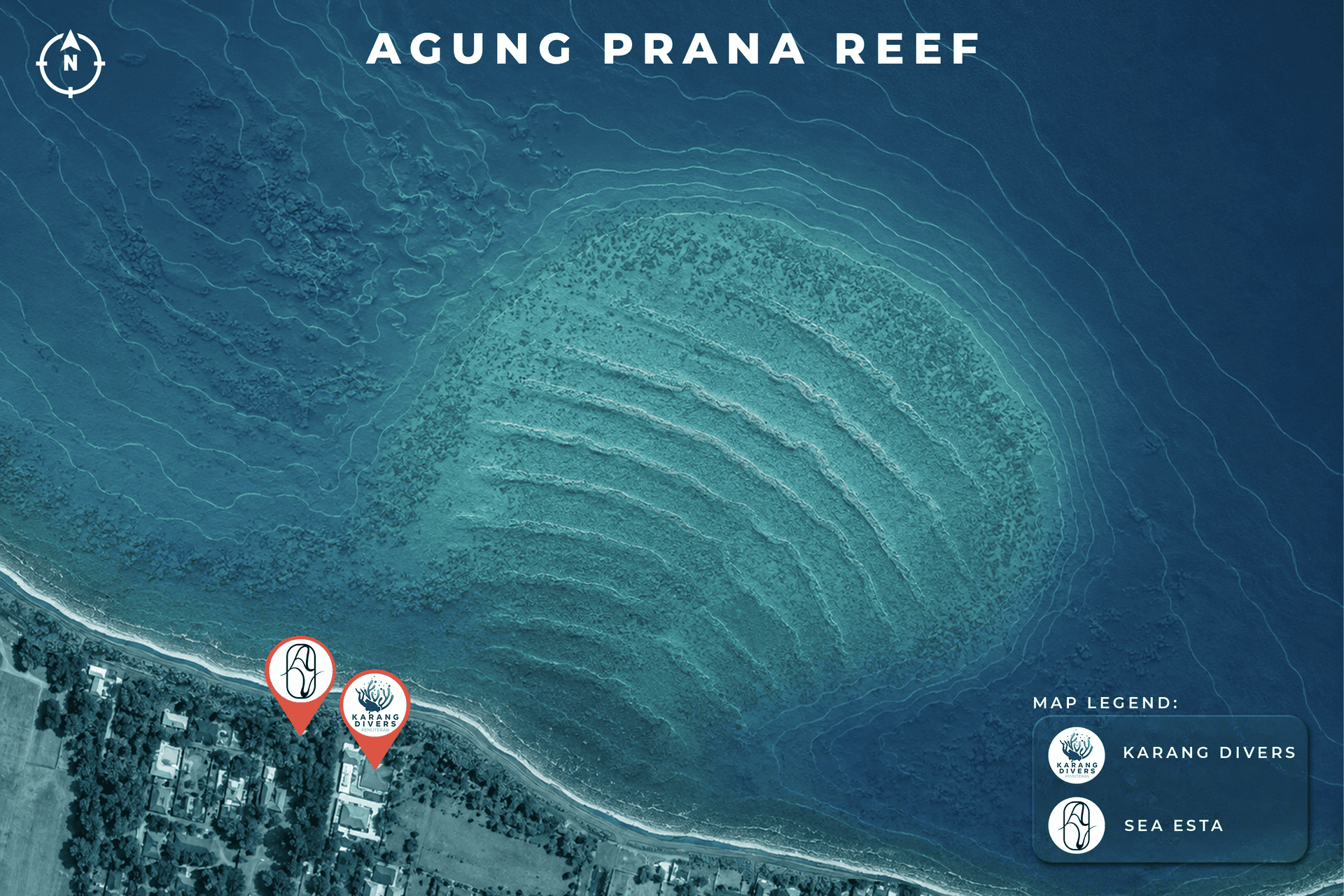
Coral restoration has been part of Pemuteran's story for more than three decades. Long before the village became known among divers for its calm bays, healthy reefs and easy access to Menjangan Island, local residents were facing declining fish populations, damaged coral reefs and limited economic opportunities. The response, when it came, was community-led rather than imposed, and the work that began in those years laid the foundation for what visitors see in the bay today.
The Agung Prana Reef Restoration carries that tradition forward as Karang Divers' own conservation project, led by marine scientist Kadek Fendi Wirawan and supported by Sea Esta by Ananda Villas. The project focuses on restoring damaged areas of the natural reef using the Natglue method, which Kadek developed. Where older restoration efforts in Pemuteran relied on artificial frameworks, the Agung Prana project works with the reef substrate itself.
As of June 2026, 1,679 coral fragments have been planted directly onto the natural reef, with a survival rate of 81.4%. The figures are based on monitoring carried out between March and June 2026, with updates made every month. For divers visiting the bay during a stay with us, the restoration site sits within easy reach of our regular dive activities in Pemuteran.
Why is it called the Agung Prana Reef Restoration?
The project is named in honour of I Gusti Agung Prana, widely known in Pemuteran as Gung Prana. He was the driving force behind Pemuteran's transformation into an internationally recognised ecotourism destination, and the story of conservation in this part of Bali cannot be told without him.
In 1989, he envisioned a future in which the village could prosper by protecting its natural resources rather than exploiting them. He encouraged villagers to commit themselves to environmental stewardship, helped establish the Karang Lestari Foundation, and supported the early reef-restoration work that followed. Pemuteran went on to receive numerous awards for that work, including the Konas Award for Best Coastal Management Project, recognition from SKAL International for underwater ecotourism, the Tri Hita Karana Award, and Sustainable Tourism Development awards.
The first coral reef restoration initiatives between 1992 and 1996 demonstrated that damaged reefs could recover when local communities actively participated in their protection. Scientists Wolf Hilbertz and Thomas Goreau later contributed to the development and implementation of Biorock technology in Pemuteran. The success of those projects relied heavily on strong community involvement, and that principle has shaped every restoration effort in the bay since.
For Karang Divers, Agung Prana was more than a respected community leader. He was also a close friend and partner who believed in people and ideas that could benefit Pemuteran in the long term. He supported Axel and Beluga Reisen in their vision of establishing a dive centre at Amertha, recognising that responsible diving tourism could contribute to conservation, education and local employment.
Naming the restoration area after Agung Prana is intended as a tribute to someone who dedicated decades of his life to protecting Pemuteran's natural heritage and encouraging others to do the same. Visitors interested in learning more about the village itself can read our guide to Pemuteran village.
The Agung Prana Reef Restoration today
The current project builds on Pemuteran's long history of community-based marine conservation while adopting a different restoration approach. The project was launched at the beginning of 2026.
Before any corals were planted, the restoration team assessed the proposed dive site and collected baseline data to determine whether it would be suitable for long-term restoration. Factors such as substrate stability, water movement, coral health and general environmental conditions were evaluated to ensure the selected location could support successful coral growth. Site selection matters more than the planting itself; coral fragments secured into a poor substrate, or in a current-stressed location, do not survive regardless of technique.
Coral planting activities began in March 2026. Since then, the restoration site has been monitored and updated on a monthly basis to track coral survival, growth and overall reef condition.
As of June 2026:
- 1,679 coral fragments have been planted directly onto the natural reef.
- The project currently shows an 81.4% survival rate.
- Local divers are employed as part of the restoration activities.
- A community scholarship programme supports educational opportunities for local residents.
The project is supported by Sea Esta by Ananda Villas and implemented under the scientific guidance of marine scientist Kadek Fendi Wirawan.
For us, these figures matter because they provide measurable information about the effectiveness of restoration efforts. Coral conservation projects often focus on the number of fragments planted, but survival rates over time are equally valuable indicators of success, and the latter is what tells you whether restoration is actually working.
Understanding the Natglue method
One of the distinctive aspects of the Agung Prana Reef Restoration is the use of the Natglue method. The Natglue method was developed by marine scientist Kadek Fendi Wirawan, who leads the scientific aspects of the project.
Instead of relying on large metal frameworks or electrical structures, the technique secures coral fragments directly onto natural reef surfaces. The objective is to encourage corals to establish themselves within the existing reef environment while minimising disturbance to the surrounding substrate. Done well, an outside observer would struggle to identify a planted fragment from a naturally settled one a year or two on. Once secured, fragments are left to integrate with the surrounding coral cover at their own pace; intervention beyond the initial attachment is kept to a minimum.
This approach differs from the older Biorock installations found in Pemuteran Bay. Biorock is an established restoration technology and is also the name of one of Pemuteran Bay's well-known dive sites. The Agung Prana Reef Restoration project does not use Biorock as its restoration methodology. Instead, it relies on the Natglue method developed and supervised by Kadek Fendi Wirawan.
Both approaches have a place in reef recovery, and Pemuteran is unusual in hosting examples of each. For divers, the practical effect is that a single bay offers both an older electrified-frame restoration site and a newer direct-attachment project, both worth understanding and both visible underwater.
Looking ahead
Coral restoration is rarely a quick process. An 81.4% survival rate and 1,679 planted corals represent encouraging progress, but they also serve as a reminder that reef recovery requires patience, continued monitoring and local involvement. The fragments planted in March will not look like a mature reef for years, and the methodology is only as good as the discipline behind the monthly checks that confirm it.
The Agung Prana Reef Restoration was created to honour a man who believed that Pemuteran's future depended on protecting the environment while creating opportunities for its people. Today, that idea continues through the work of Kadek Fendi Wirawan, local restoration teams, community scholarship programmes, and visitors who choose to support conservation-minded tourism.
For visitors, part of the value of a project like this is that it can be observed first-hand. Dive sites elsewhere often celebrate planting figures but rarely publish ongoing survival data, and that gap is what makes the monthly monitoring approach unusual. The 81.4% figure reflects what is currently growing on the reef, not what was attached six months ago and may or may not have survived. As the project continues, those numbers will be updated, and the underlying point will remain the same: in coral restoration, survival is the real result.