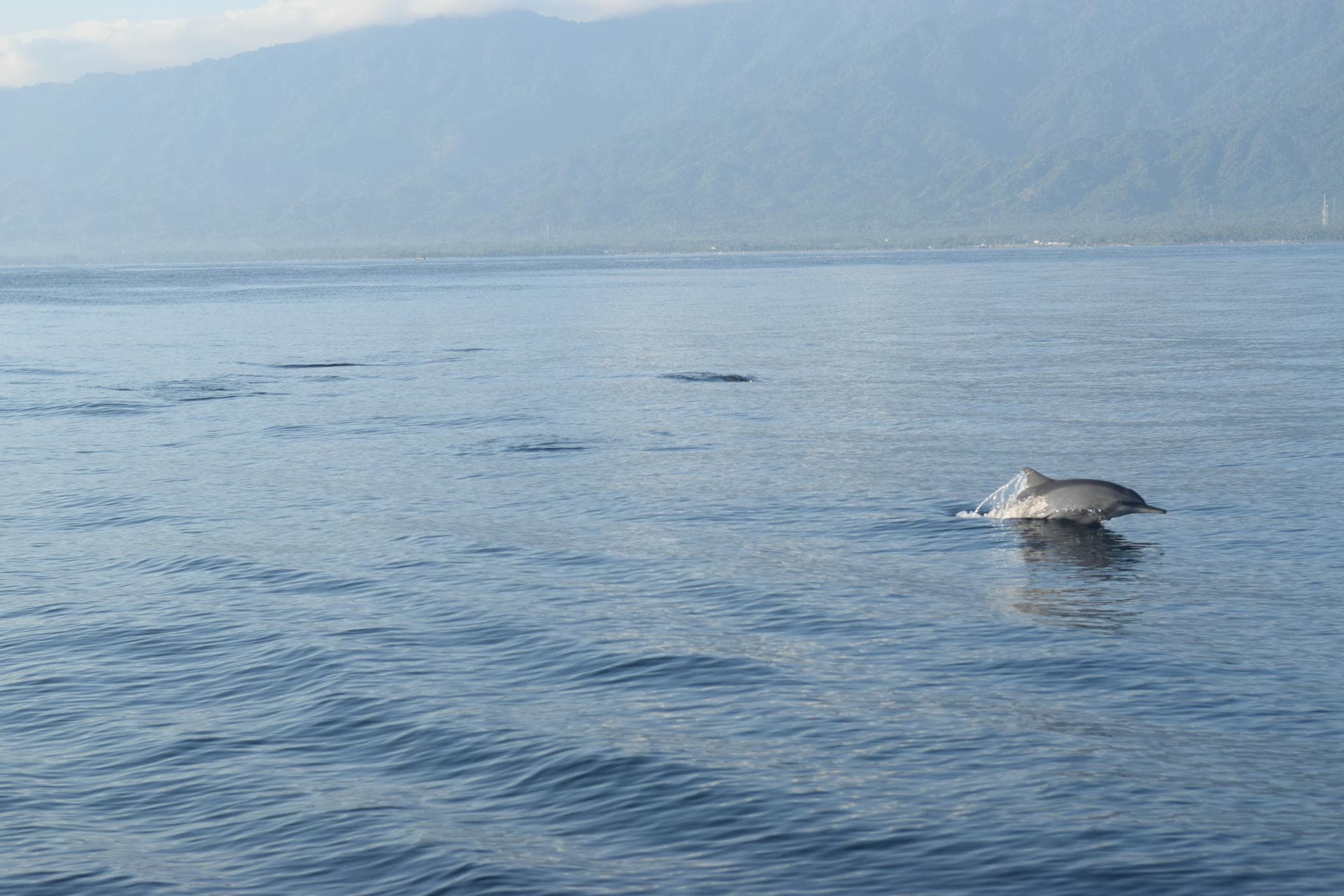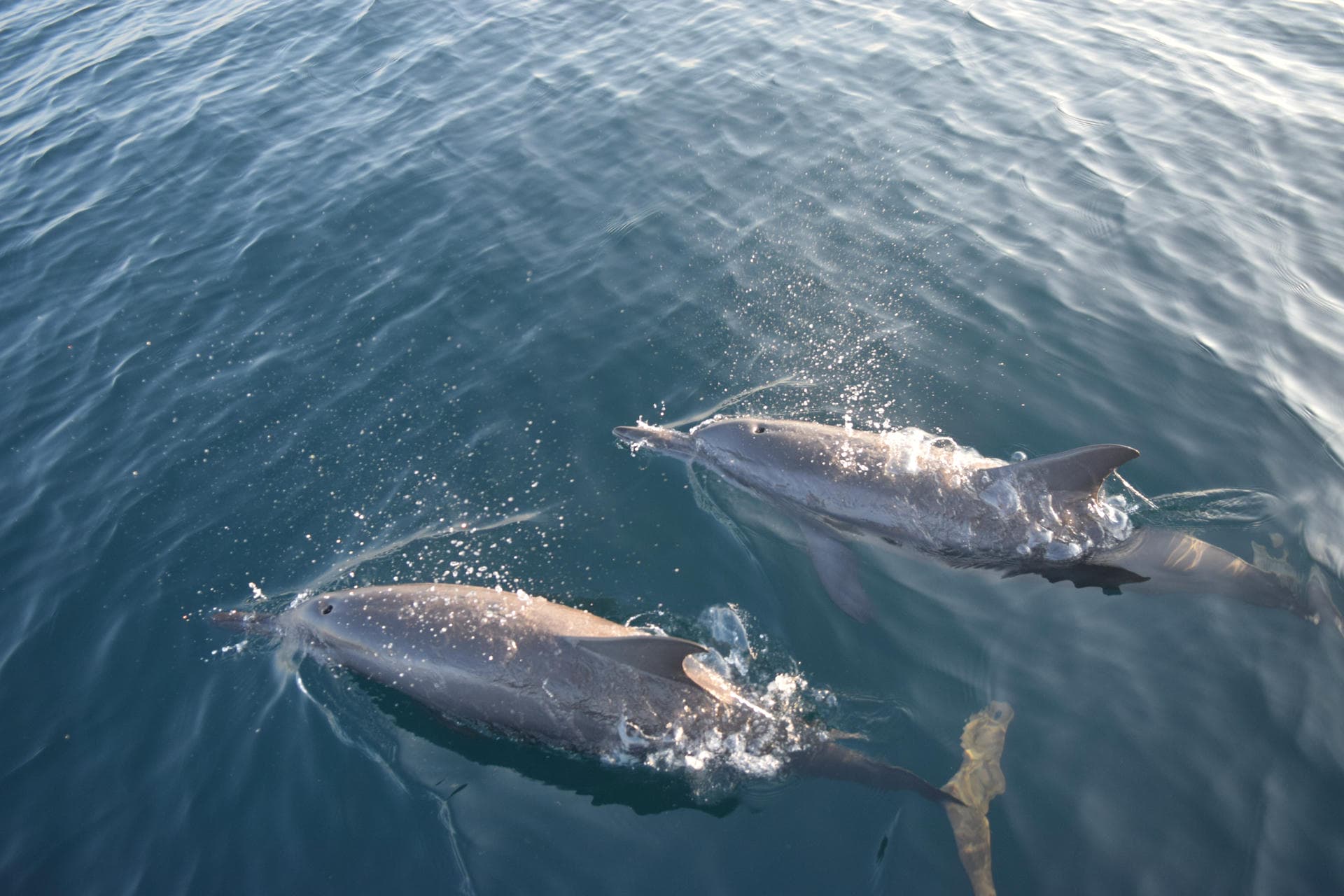
Six in the morning, two miles out
The water off Pemuteran Bay is at its quietest just before sunrise. The bay sits in the lee of the Prapat Agung peninsula, and the surface holds flat through the small hours, so from the jetty you can hear the hull of Karang Divers 03 settling against its lines while the first coffee is poured on deck. At five to six the engine starts. It is a four-stroke, set to idle, and the sound it makes is closer to a domestic generator than to the rasping two-strokes that work other parts of the North Bali coast.
By six the boat is leaving the jetty. The marine biologist on board has already given a short briefing: where we are going, what we may see, and how the boat will behave around the pods. The route runs roughly north-west, two miles out into deeper water, towards the point where the bay floor begins to fall away. The sky is lightening but the sun has not yet broken over the ridge of Bali behind us.
You hear the dolphins before you see them. That is the part nobody tells you. A pod's breath, when fifteen or twenty animals surface together, carries across calm water in a way the eye takes a moment to catch up with. Then the dorsal fins appear, low and quick, and the raised observation deck above the wheelhouse fills with quiet movement as people stand to look.
These are wild pods on their own routes. They are not corralled, not fed, not chased. Where they go in the morning is their decision; our job is to be in approximately the right water at the right time and to behave correctly when we meet them. Six recognised cetacean species pass through these waters in the course of a year. What follows is a short field guide to each of them, beginning with the one most divers come hoping to see.
Why Pemuteran Bay has wild pods
The reason cetaceans are easy to find here is bathymetric, not coincidental. North-West Bali sits on the edge of the Bali Sea, and the seabed off Pemuteran drops sharply within a few kilometres of shore. Deep-water dolphins do not need to be sought twenty miles offshore the way they often do on the island's south coast. The water they prefer is essentially next door.
The Bali Sea itself is rich. Currents push through the narrow passages between Bali and Java to the west, and between Bali and Lombok to the east, bringing cold, nutrient-laden water up from depth. That upwelling supports the small pelagic fish and squid that dolphins feed on, and the predictable food supply keeps pods in the area year-round rather than passing through.
The other factor is the surface environment. Pemuteran Bay is sheltered, comparatively quiet, and far less developed than the south of the island. Engine noise on the water is lower. Boat density is lower. Cetaceans tolerate the surface above them when it stays calm, and this stretch of coast is one of the calmer in Bali.
The six species
Spinner Dolphin (Stenella longirostris) — the headline species
The first species most guests see, and the one that gives the trip its visual signature, is the Spinner Dolphin (Stenella longirostris). They are smaller than most divers expect; adults rarely exceed two metres, and they move in pods that can range from a handful of animals to several dozen.
Their name comes from the spinning leap, a long-axis rotation that can take an animal completely clear of the water and turn it three or four times before it lands. Why they do this is still genuinely debated. The leading theories involve dislodging parasites, communicating with other group members, or simply using surplus momentum after fast feeding. It is likely a combination, and likely different in different contexts.
In Pemuteran Bay, Spinner pods tend to appear in the deeper water off the headland, often feeding through the early morning before resting in shallower water through the heat of the day. They are the most demonstrative of the local cetaceans and the easiest to identify from a distance, which is why most guests on our Pemuteran dolphin tour see them first.
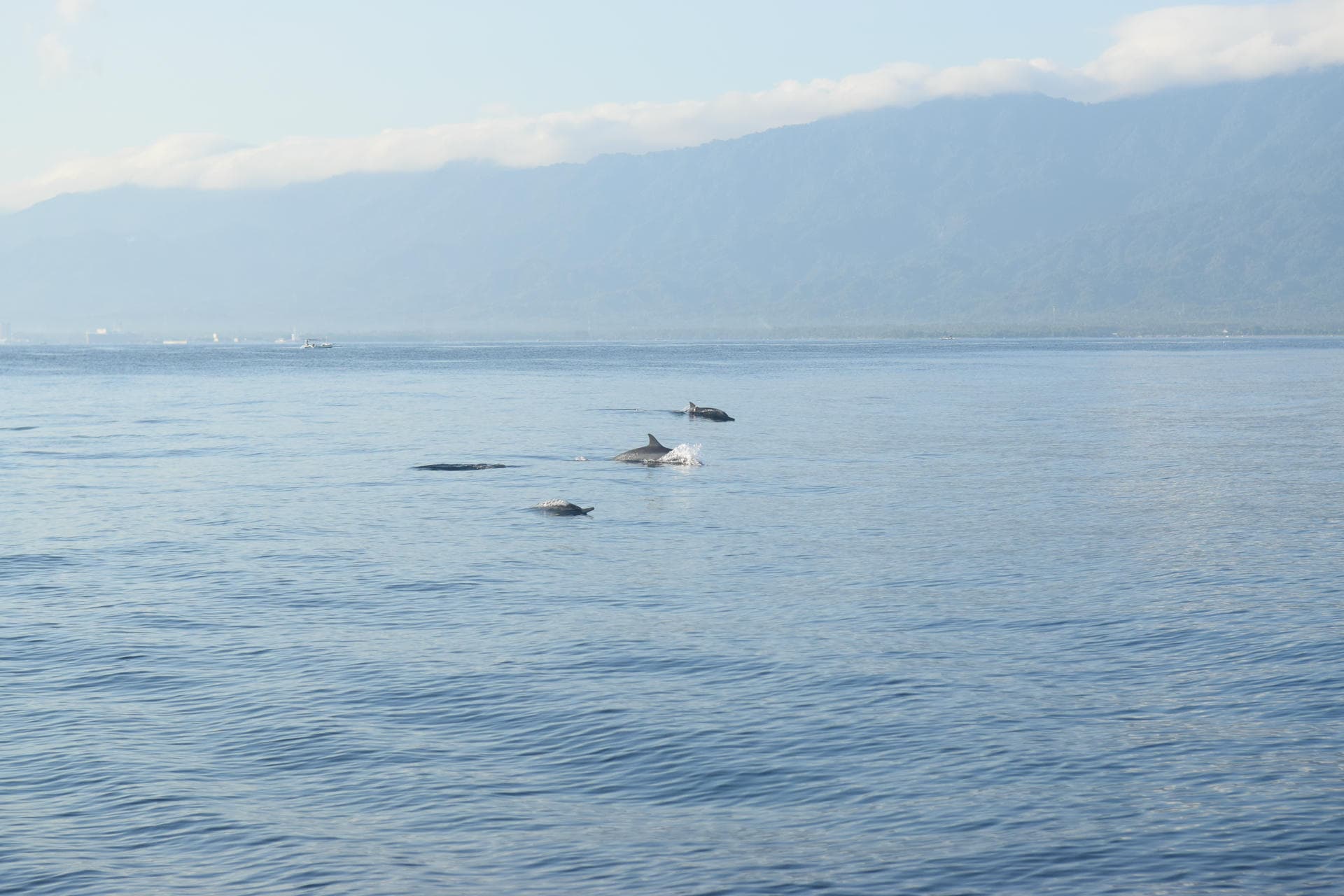
Bottlenose Dolphin (Tursiops truncatus) — large, social, year-round
The Bottlenose Dolphin (Tursiops truncatus) is the species most people picture when they hear the word "dolphin", and it is one of the most reliable sightings off Pemuteran. Bottlenose are larger than spinners. Animals of three metres are not unusual here, and they are bulkier, with the heavy, blunt-snouted profile that is unmistakable once you have seen it.
Pods are highly social and complex. Bottlenose live in fluid groups, with adult males forming long-lasting alliances and females associating along kinship lines. They hunt cooperatively, sometimes driving fish against shorelines or reefs in a coordinated push, and they will often work the shallower margins of Pemuteran Bay rather than the deeper water the spinners prefer.
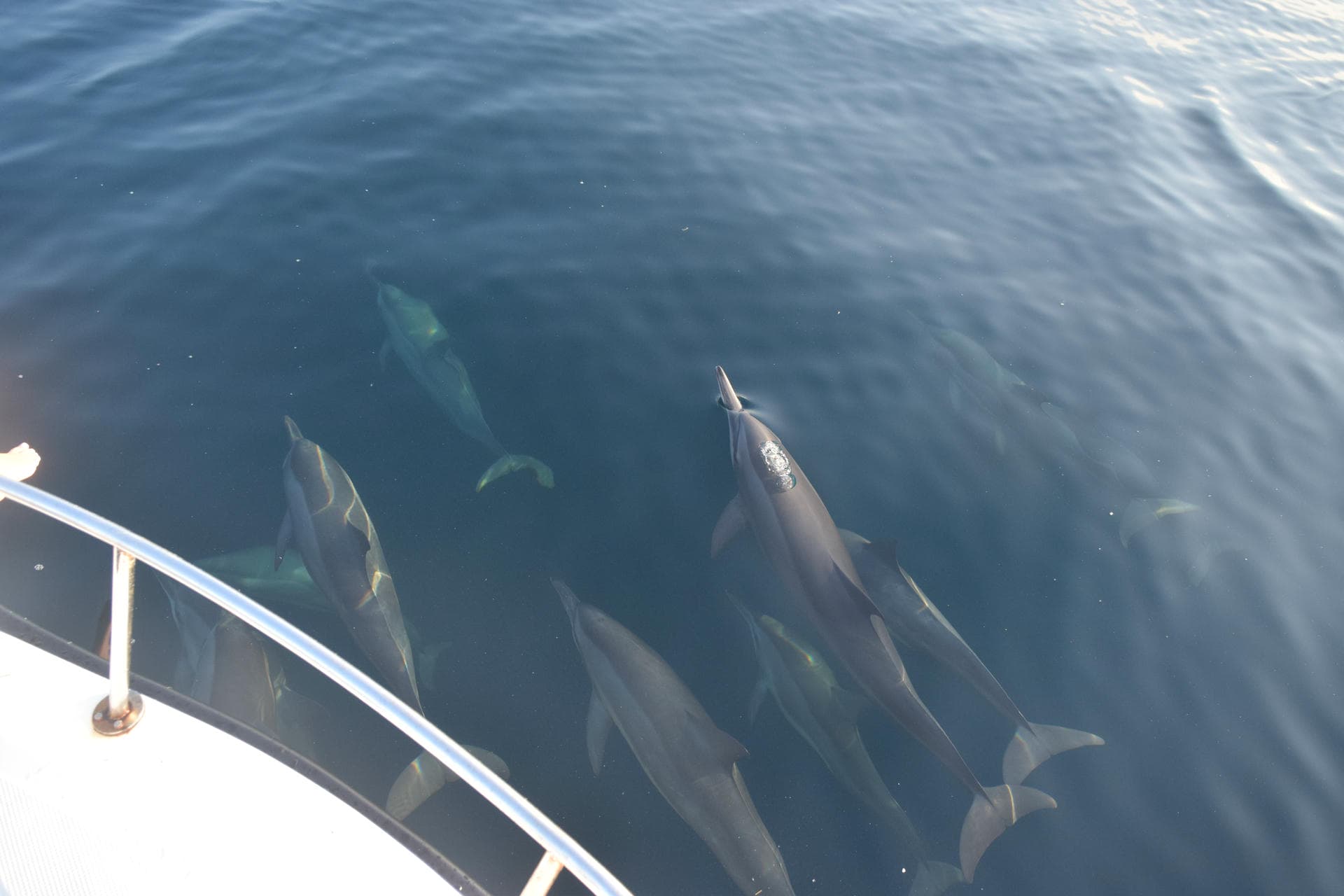
You see them year-round. They are the species most likely to bow-ride alongside the boat, swimming a few metres off the hull and turning a deliberate eye up at the people on deck. That returned gaze is part of why bottlenose, more than any other dolphin, sit in the public imagination the way they do.
Pantropical Spotted Dolphin (Stenella attenuata) — speed and spots
The Pantropical Spotted Dolphin (Stenella attenuata) is one of the harder species to identify at distance, because the spots that give it its name only develop with age. Juveniles are plain grey, calves are almost uniform. The freckled pattern appears in the second or third year, deepens through adulthood, and in older animals can cover the flanks and belly densely enough to look mottled.
They are fast. Pantropical Spotted swim with short, urgent surfacings and often travel in mixed-age pods that move through an area quickly. From the boat deck, the cue is usually the pace of the surfacing rather than the colour pattern, which only resolves once a pod is within fifty metres.
They bow-ride enthusiastically, which is the moment to look for the spots. A spotted adult riding a metre off the hull is one of the more memorable sightings of any trip. In Pemuteran Bay, they tend to share water with spinners and are sometimes seen in the same pod, which makes the visual distinction useful.
Fraser's Dolphin (Lagenodelphis hosei) — the rarer deep-water visitor
Fraser's Dolphin (Lagenodelphis hosei) is the species that occasions the longest pause from the marine biologist on board. They are uncommon here, comparatively understudied, and a confirmed sighting is the kind of detail that gets noted down at the end of the morning.
The dolphin itself is compact, with very small flippers and a short beak. The diagnostic feature is a dark facial stripe that runs from the eye back along the flank, often called a "bandit mask". In good light, against the right surfacing angle, it is unmistakable. In poor light it is easy to overlook entirely.
Fraser's are a deep-water species. They prefer offshore conditions and tend to surface in tight, fast-moving groups, sometimes mixed with melon-headed whales or other oceanic dolphins. The chance to see them at all is one of the reasons North-West Bali rewards repeat visits. Several mornings in a row may give nothing; the morning you do not expect them is often the morning a pod surfaces a hundred metres ahead of the boat.
Risso's Dolphin (Grampus griseus) — the scarred elders
Risso's Dolphin (Grampus griseus) is unlike the others in almost every respect, and once you have seen one you do not confuse it again. Adults are large, pale, and increasingly white with age, and their bodies carry a heavy network of scars: rake marks from the teeth of other Risso's, the smaller circular marks left by squid suckers, and the long scratches of intra-pod interaction.
The head is blunt and squared, with no obvious beak. The dorsal fin is tall and falcate. Older Risso's can look, at distance, almost like a small beaked whale, and the absence of acrobatics is part of the cue. Where spinners are leaping and bottlenose are bow-riding, Risso's surface deliberately, breathe, and submerge again.
They are squid specialists. The scarring is partly the cost of that diet. Risso's hunt at depth and surface in smaller, looser groups, often a handful of animals rather than the larger pods of the other species. Sightings in Pemuteran Bay are seasonal and irregular, but the animal is distinctive enough to confirm at a glance.
Melon-headed Whale (Peponocephala electra) — the occasional bonus
Despite the common name, the Melon-headed Whale (Peponocephala electra) is an oceanic dolphin, and not a particularly large one. The "whale" in the name reflects an older taxonomy and the animal's superficial resemblance to a small pilot whale, with a rounded, blunt head and a dark, uniform body.
What sets them apart is the group behaviour. When melon-headed whales appear they appear in numbers. Pods of several hundred are documented elsewhere in their range, and the species moves in tight, fast-travelling formations that can take ten minutes to pass a stationary boat. They are deep-water and offshore by preference, and they reach the inshore waters off Pemuteran rarely enough that a sighting tends to reorganise the rest of the morning.
For a guest, the experience is unmistakable: the surface around the boat fills with low, dark backs, hundreds of them, all moving the same direction. The marine biologist will usually call it before anyone else, but you will know what you are looking at within a minute.
How we move around a pod
How a boat behaves around dolphins matters more than most guests realise, and it is the main reason this trip is structured the way it is.
The principle is simple: never approach a pod head-on, never approach from behind. Either trajectory is read by the animals as a chase, and chase behaviour from a boat is what teaches dolphins to flee from human contact. We approach parallel, on a slow line, from a distance. The engine stays at low revs. We let the pod set the spacing.
We move on within roughly thirty minutes. The reason is straightforward. The morning is when these animals feed, and feeding is the activity most easily disrupted by surface intrusion. A pod that has been worked by three boats for an hour each does not eat. The thirty-minute window is short enough that no individual pod is crowded through its breakfast.
There is no feeding. There is no swim-with. The first creates dependence and changes wild behaviour. The second turns the encounter into a chase regardless of intent, because dolphins faced with people in the water tend to choose distance over engagement. The boat stays the boat, and the dolphins stay wild.
The marine biologist's role on board is part briefing, part narration, and part guarantor of the rules. They tell you what you are seeing as it happens, they answer the questions guests want to ask, and they ensure that the trip remains an ethical sunrise dolphin tour rather than a chase.
When the pods are around
Bali Sea cetaceans are broadly year-round, which is the answer guests usually want to hear and which happens to be true. Pods are not migratory in the way Antarctic baleen whales are; they live here. What changes from month to month is the surface conditions, not the animals.
The dry season runs from roughly April to October, and it is the easier season for this trip. Seas are flatter, mornings are clearer, and visibility from the deck stretches further. October and November also bring an increase in larger pelagic activity through the Bali Sea more generally, which the dolphins respond to.
The wet season, November to March, has dolphins too, in the same numbers, but the surface gets choppier and the boat ride is less comfortable on rough mornings. We will not run the trip if the conditions do not suit it.
The time of day matters more than the season. Pods are active and feeding in the period from first light to about eight in the morning, before the heat of the day, before the regular boat traffic, and before the wind comes up off the strait. That is why the trip departs when it departs.
If you'd like to come out with us
The Pemuteran Dolphin Watching & Sunrise Tour runs from our jetty in Pemuteran with a 6 AM departure (arrive 5.45 AM). The trip lasts approximately two hours. A small breakfast of coffee, tea, and Balinese snacks is served on board.
The boat is Karang Divers 03, with a raised observation deck and a quiet four-stroke engine. A marine biologist is aboard each trip, alongside a local dolphin expert. The group is held to a maximum 12 guests, with a minimum 3 persons to run. The fare is IDR 550,000 per person.
If diving in Pemuteran is part of the same trip, the dolphin tour fits naturally before or after a dive day, since it ends well before the morning dive briefing. You can book the sunrise dolphin tour through WhatsApp or the contact form.